Checked against LTA's pages on 17 November 2026
LTA's Mobility Scooter and PMA Rules in Singapore: What Applies to You, and When
New LTA rules for mobility scooters, motorised wheelchairs and other personal mobility aids (PMAs) in Singapore started on 1 June 2026, and more follow in mid-2027 and on 1 January 2029. Some rules bind the person riding, some the device, and some whoever sells it. This page sorts each rule by who it applies to, gives the date it starts, and links to LTA's own page so you can check your own case.
What changed on 1 June 2026
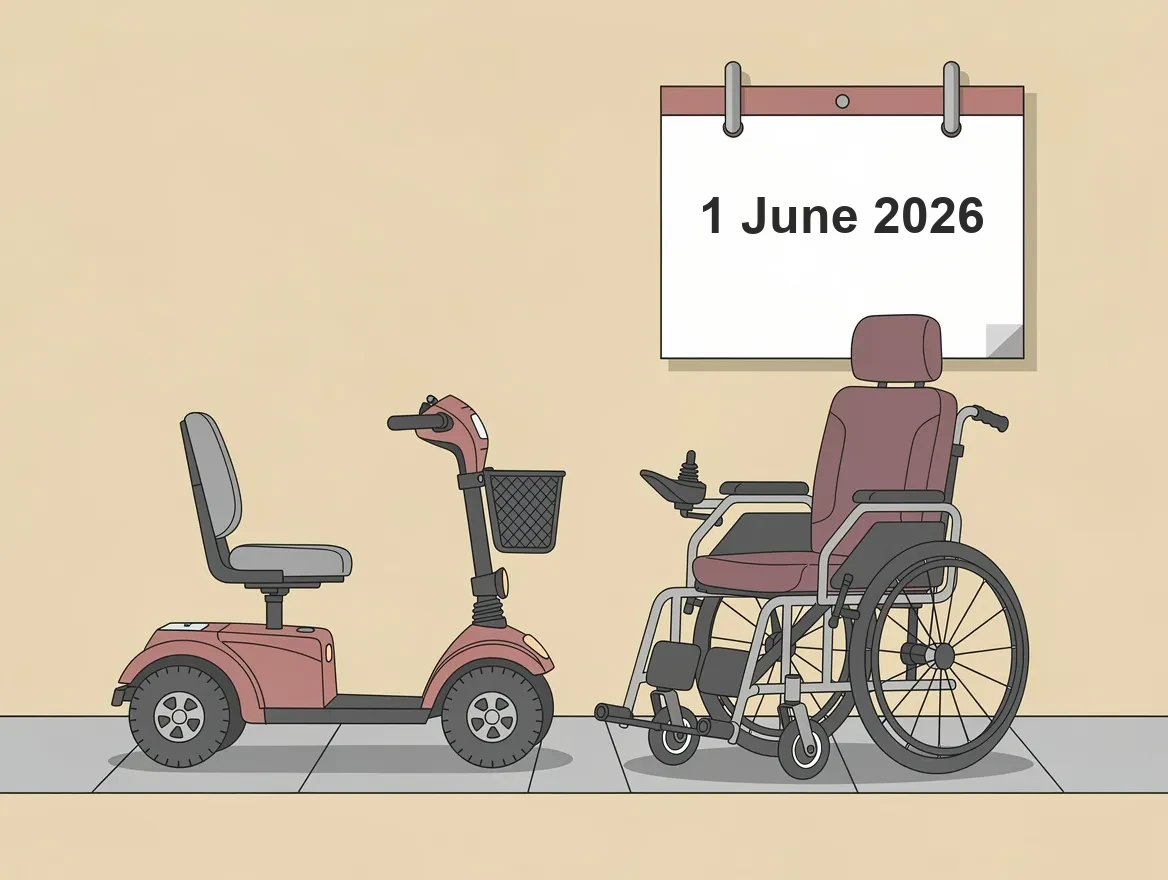
- Mobility scooter riders need a Certificate of Medical Need to ride on public paths, unless they are exempt.
- Every motorised PMA must keep to 6 km/h on public paths, down from 10 km/h.
- Every PMA on a public path must fit size and weight limits, 70 cm wide, 120 cm long, 150 cm high and 300 kg with the rider, unless the rider's need for a bigger device is certified.
- Shops may display, advertise or sell only registered mobility scooters.
Mobility scooter or motorised wheelchair: which kind LTA says you have
LTA's certificate and registration rules are written for mobility scooters and their equivalents, while the speed and size limits cover every PMA. So the first question is which kind of device LTA would say you have. Work through these steps in order.
First, is it a PMA at all? Look at the controls
Before the mobility scooter or wheelchair question, make sure the machine is a PMA and not a lookalike personal mobility device (PMD).
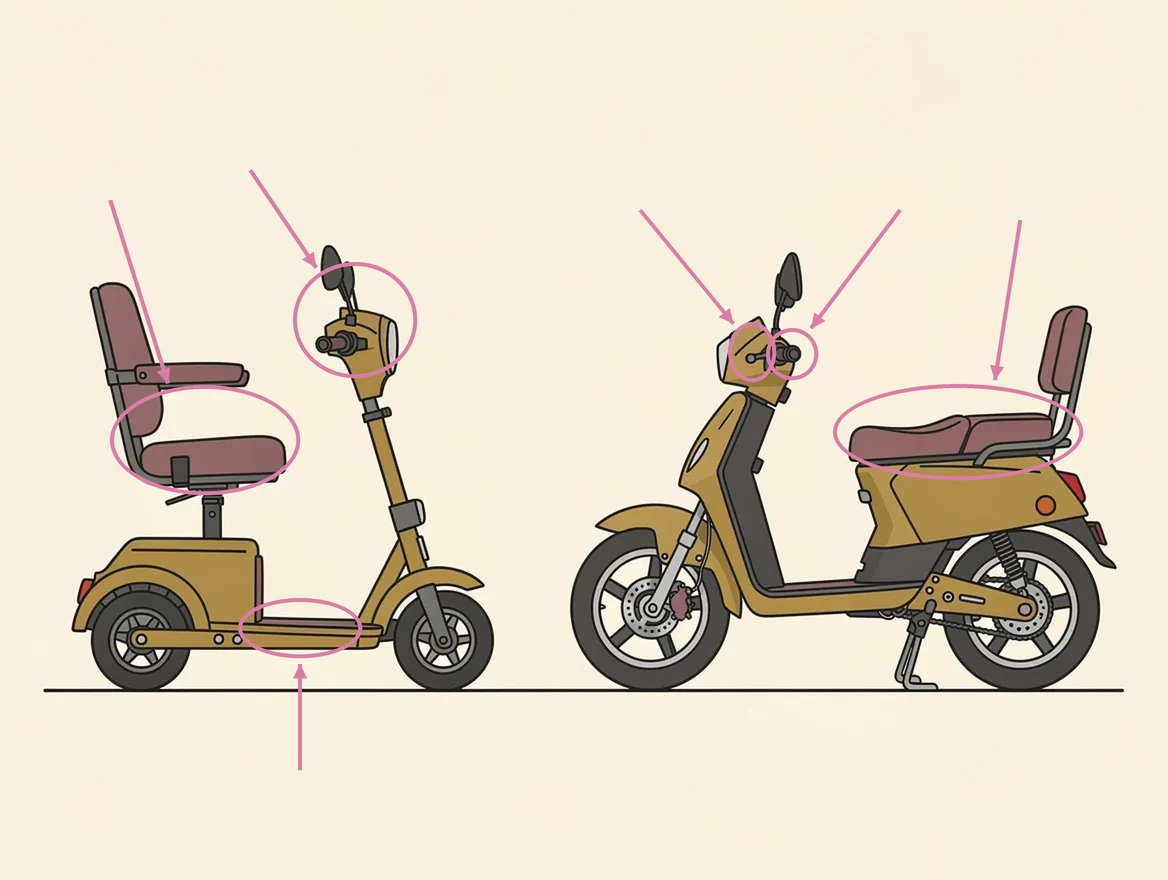
The first check Kelvin, our engineer, uses for this is the controls. The mobility scooters we work on are driven by levers that stop the machine when you let go, and they have an electromagnetic brake, so they suit a rider with one usable hand. A machine with a throttle and brake handles is usually a lookalike PMD. This is only a first hint: LTA's own conditions in step 3 decide.
LTA's definition of a PMA
LTA says personal mobility aids (PMAs) are manual wheelchairs, motorised wheelchairs and mobility scooters, designed to carry a person who cannot walk or has difficulty walking. If your device is one of these, the rules on this page apply to it; the next steps say which ones.
LTA's five conditions for a mobility scooter
LTA says a mobility scooter must meet all five of these. Check each one against your device:
- Three or more wheels, and a single footboard supported by the wheels.
- Steered by handlebars. A delta tiller, the wraparound steering handle some mobility scooters have instead of two straight bars, counts as handlebars.
- Only one seat, behind the footboard.
- Designed to carry only one person who is unable to walk or has difficulty walking.
- Driven by a motor that forms part of the vehicle.
If every answer is yes, LTA's rules for mobility scooters apply. LTA's lookalike sheet says lookalikes typically have more than one seat for pillion riders.
Mobility scooter equivalents
A manual wheelchair with a detachable motorised attachment steered by handlebars is what LTA calls a mobility scooter equivalent. LTA applies the certificate rule and the registration rule to it, as it does to a mobility scooter. If you fit such an attachment to a manual wheelchair, plan for both.
Motorised wheelchairs
A motorised wheelchair, often called an electric wheelchair, is described by MOT as one propelled by a motor that forms part of the wheelchair and usually operated by a joystick. MOT calls motorised wheelchairs and mobility scooters together mobility vehicles.
LTA's pages give no separate checklist for a motorised wheelchair. If your powered wheelchair fails any of the five conditions in step 3 and is not a handlebar-steered attachment, it is not a mobility scooter in LTA's terms, and the motorised wheelchair column in the table below is the one to read. Still unsure? Ask LTA at LTA_PMA_Feedback@lta.gov.sg before you rely on either column.
Want more help telling a PMA from a lookalike PMD? See LTA's sheet on mobility scooters and their lookalikes (PDF) or our guide to telling PMAs and PMDs apart.
Why it matters: the rules for each kind
| Rule | Mobility scooter or equivalent | Motorised wheelchair |
|---|---|---|
| Certificate of Medical Need, from 1 June 2026 | Needed to ride on public paths, unless you are exempt | Not currently needed, as MOT said in February 2026 |
| Registration | New ones sold by shops are registered from 1 June 2026. Every one used on public paths must be registered by 1 January 2029 | No registration rule for motorised wheelchairs on the LTA pages we read. Ask LTA if unsure |
| Speed on public paths, from 1 June 2026 | 6 km/h at most | 6 km/h at most |
| Size and weight on public paths, from 1 June 2026 | Within LTA's limits, unless the rider is certified for a bigger device | The same limits, with the same certified exception |
| Roads | Not allowed | No riding rule for roads on the LTA pages we read. Ask LTA if unsure |
Rules for the person riding: the Certificate of Medical Need
From 1 June 2026, anyone riding a mobility scooter, or a mobility scooter equivalent, on a public path needs a Certificate of Medical Need, unless they are exempt. The certificate comes from a medical check called the Assessment for Mobility Scooter (AMS). The rule is about the person riding, not the device.
Who does not need the certificate
- Seniors aged 70 and above. LTA counts age by year of birth.
- People who received a subsidised mobility scooter under the Seniors' Mobility and Enabling Fund (SMF) before 27 February 2026.
- Everyone who has received, or will receive, a subsidised mobility scooter under the Assistive Technology Fund (ATF).
- Past and future applicants to Ministry of Health (MOH) disability schemes who were assessed with needs in Mobility or Transferring in daily living.
- People with physical disabilities known to the Ministry of Social and Family Development (MSF) who were assessed with those same needs.
Visitors on a short-term visit pass may show a medical certificate or a doctor's memo from their home country instead. Anyone applying to SMF for a subsidised mobility scooter on or after 27 February 2026 takes the AMS as part of that application.
Not sure whether you are in one of the groups above? The status check below shows whether you are exempt.
How to get the certificate
Since 27 February 2026, the AMS has been open to mobility scooter riders. These are the steps.
Choose who does the AMS
A Singapore-registered doctor or occupational therapist does it. You can go to your regular doctor or therapist, or to a GP clinic on LTA's list of clinics that offer the AMS.
Call the clinic first
Fees vary with the consultation, so check that the clinic does the AMS and what it charges before you go. Ask, too, whether it can send the form to LTA digitally; if not, print LTA's paper form and bring it.
Have the assessment
The doctor or therapist assesses whether you have a medical need for a mobility scooter. Sometimes a follow-up check by an occupational therapist is needed to see that you can ride a mobility scooter safely.
Make sure it reaches LTA
The clinic sends the digital form, or you send LTA a photo of the signed paper form through LTA's online form. Once you are certified, you can ride straight away.
LTA's OneMotoring site has a status check: enter your NRIC and date of birth to see whether you are certified or exempt. A new certificate can take up to a week to show. Seniors aged 70 and above are exempt automatically but are not shown in the check, and LTA says they do not need to use the check unless they need a device bigger than the limits.
MOT said in Parliament on 3 February 2026 that riding a mobility scooter on a public path without the certificate can mean a fine of up to $2,000, jail of up to six months, or both. This is for riders who are neither certified nor exempt.
LTA says enforcement officers will ask for a rider's particulars to check, and will focus on people who are visibly able-bodied. MOT gave these penalties when the law was debated, and LTA's rules pages do not repeat them.
Using a motorised wheelchair? You do not currently need the certificate. See which kind LTA says you have.
Rules for the device: speed, size and weight on public paths
Since 1 June 2026, every motorised PMA must go no faster than 6 km/h on public paths. This applies to mobility scooters and motorised wheelchairs.
The limit used to be 10 km/h. MOT said in Parliament that riding faster than 6 km/h on a public path can mean a fine of up to $2,000, up to six months' jail, or both. A separate rule on the device's own top speed starts on 1 January 2029: the dates section below explains it.
Size and weight on public paths
Since 1 June 2026, every PMA used on a public path must fit within these limits, the same ones that already applied on public transport.
- Width
- 70 cm at most
- Length
- 120 cm at most
- Height
- 150 cm at most, from the floor to the top of the device or the rider's head, whichever is higher
- Laden weight
- 300 kg at most, with the rider on board
If you need a bigger device
A bigger device may still be used on public paths if a healthcare professional certifies that you need it.
For an oversized mobility scooter, that is done through the AMS. LTA says this AMS step does not apply to people with a subsidised mobility scooter from SMF or ATF; if that is you and your device is bigger than the limits, ask LTA what you need to show. Seniors aged 70 and above may use the AMS or give LTA a doctor's memo. An oversized motorised wheelchair, or a manual one, uses LTA's separate wheelchair assessment form instead.
Even when the rider's need is certified, an oversized PMA cannot be taken on trains or buses. MOT said riding an oversized device on a public path without that certification can mean a fine of up to $10,000, jail of up to six months, or both.
LTA says mobility scooters can be used on all public paths. Its lookalike sheet lists these as pedestrian-only paths, footpaths, cycling paths and shared paths.
Mobility scooters are not allowed on roads. For motorised wheelchairs, no LTA page we read states a riding rule for motorised wheelchairs on roads. If that matters to you, ask LTA at LTA_PMA_Feedback@lta.gov.sg.
Dates for a device you already own
If you already own a PMA, these are the dates that matter. Each one says which device it applies to.
27 February 2026
Mobility scooter riders could start taking the AMS for the Certificate of Medical Need. It is also the cut-off for the SMF exemption: only people who received an SMF-subsidised mobility scooter before this date are exempt.
1 June 2026
Mobility scooter riders need the certificate unless they are exempt; motorised wheelchair users currently do not. Every motorised PMA must keep to 6 km/h on public paths, and every PMA must fit the size and weight limits. Shops may display, advertise or sell only registered mobility scooters.
Second quarter of 2027
LTA's rules on selling and advertising active mobility devices, mobility scooters among them, extend to online sales, such as a standalone website or an online marketplace. Planning to sell a used mobility scooter online? Read the section on buying and selling first.
Mid-2027
LTA starts registering existing mobility scooters at roving stations in the community, after checks on the device and on the rider. LTA says more details will be released later. Its pages do not name motorised wheelchairs here.
31 December 2028
The last day an existing PMA with a top speed of up to 10 km/h may still be used. Until then it must keep to 6 km/h on paths and meet all the other rules.
1 January 2029
No PMA may have a top speed above 6 km/h, and every mobility scooter used on a public path must be registered. MOT said riding an unregistered one can mean a fine of up to $2,000, jail of up to three months, or both.
If you ride a mobility scooter, check your certificate or exemption status on OneMotoring. Seniors aged 70 and above are exempt and are not shown there, and motorised wheelchair users need no certificate. You can also tell LTA now that you want to register your mobility scooter, and LTA will contact you when registration opens.
Find your device's top speed in its manual or on the maker's label. If it is above 6 km/h, LTA suggests asking the shop that sold it whether the speed can be adjusted safely.
Not sure what its top speed is? We can check it for you.
Check its size, and its weight with the rider on board, against the limits too. If it is bigger, the rider's need for a bigger device must be certified to keep using it on public paths, as the device section explains.
MOT told Parliament that only compliant mobility scooters will be registered, and asked owners of devices that go above the 6 km/h top speed or the size and weight limits to replace them by 1 January 2029. The pages we read do not say how registration will treat a bigger mobility scooter whose rider is certified to need it. If that is your case, ask LTA at LTA_PMA_Feedback@lta.gov.sg before you decide to keep or replace it. If you decide to replace it, you can ask us about trading it in toward another unit; our PMA trade-in page explains how.
Buying or passing on a used mobility scooter: the rule checks before you pay
Before money changes hands, settle which of three cases you are in, because the rule checks differ for each. Advice on choosing a used unit is on our second-hand PMA page, linked at the end of this section.
This covers any mobility scooter a shop sells. Since 1 June 2026, a shop may display, advertise or sell only registered mobility scooters, and a new mobility scooter can be registered for sale only if its model is on LTA's whitelist.
Before the sale, the shop checks on OneMotoring that you have a Certificate of Medical Need or are exempt, and the sale is complete only when ownership is transferred to you. A buyer aged 70 or above is exempt but is not shown in that check, so ask the shop or LTA how it will be confirmed. LTA publishes the whitelist of models and approved shops, and says it does not endorse the models or shops listed.
Case 2: a registered mobility scooter passing between owners
A registered mobility scooter changes hands on OneMotoring, LTA's online portal. LTA will not approve the transfer if the new owner has no Certificate of Medical Need and is not exempt, so do these steps in order, before anyone pays.
Check the new owner
The current owner checks that the new owner has a Certificate of Medical Need or is exempt. If the new owner is 70 or above, ask LTA how the transfer confirms the exemption, since seniors are not shown in the online status check.
Start the transfer
The current owner logs in to OneMotoring with Singpass and keys in the new owner's NRIC and date of birth. The transfer starts only if the new owner is eligible to use a mobility scooter.
The new owner accepts
A new owner with Singpass gets an SMS and accepts on OneMotoring within 5 calendar days. A new owner without Singpass: the current owner also sends LTA a FormSG form with the new owner's details and consent, and LTA approves within 5 calendar days if the new owner is eligible.
Case 3: an existing mobility scooter that is not yet registered
Registration for existing mobility scooters opens only in mid-2027, so an older device may not be registered yet. These are the official lines that bear on selling one.
- LTA's whitelist: from 1 June 2026 it is an offence to sell, display or advertise an unregistered mobility scooter.
- LTA's rules for retailers: since 1 June 2026, shops may display, advertise or sell only registered mobility scooters.
- MOT in Parliament: selling an unregistered mobility scooter for use on public paths is an offence from 1 June 2026, with penalties for individuals of up to $20,000, jail of up to 24 months, or both.
- LTA's rules for retailers, from the second quarter of 2027: the sale and advertising rules extend to online sales, such as a standalone website or an online marketplace, and displaying, selling or advertising an unregistered mobility scooter is listed as an offence. An advert is allowed only if it clearly says the device will be registered before it is delivered.
Check the machine's age and wear, battery and charger, motor and brakes, tyres and wheels, controls, frame and seat. Try it before you pay, and check whether it is a mobility scooter or a motorised wheelchair because different rules apply.
Ask for a receipt or other proof of ownership. A used PMA from DrWheelchair comes with our sales receipt.
These checks apply to a used motorised wheelchair as well as a used mobility scooter. Ask for the top speed. An existing device with a top speed of up to 10 km/h may be used only until 31 December 2028, and MOT said that selling a mobility vehicle (a mobility scooter or a motorised wheelchair) with a device speed above 6 km/h is an offence from 1 June 2026.
Check its size, and its weight with the rider, against the limits in the device section above. MOT said only compliant mobility scooters will be registered; if a mobility scooter is bigger than the limits because its rider is certified to need it, ask LTA how registration will treat it before you buy.
"HSA compliant" and "LTA registered": what each label tells you
Sellers often describe a PMA in Singapore as HSA compliant. Here is what that label can and cannot tell you about a mobility scooter, set beside LTA's own marks.
HSA's part
Mobility scooters are Class A medical devices under the Health Products Act. Businesses that import, make or wholesale them need a medical device dealer licence from the Health Sciences Authority (HSA), and each model must be listed on HSA's Class A Medical Device Database.
For mobility scooters sold from 1 June 2026, LTA whitelists and registers only models on that database. MOT said existing mobility scooters do not need to meet this database requirement.
LTA's part
From 1 June 2026, only whitelisted models can be registered for sale. At registration, one of LTA's Authorised Inspection Centres checks the device's size and its 6 km/h top speed, then fixes a Registration Mark and an Identification Mark to it. An existing mobility scooter gets these marks only once it is registered, from mid-2027.
What "HSA compliant" does and does not tell you about a PMA
On its own, "HSA compliant" does not tell you that a mobility scooter meets LTA's speed, size or registration rules.
HSA's listing is about the device as a medical device. LTA's rules are about selling it and riding it on public paths. The checks below fill that gap.
- Buying a new mobility scooter from a shop: look for the model and the shop on LTA's whitelist, and for the Registration Mark and Identification Mark on the device.
- Buying any used mobility scooter: follow the three cases in the section on buying used before you pay.
- Keeping one you already own: no marks are expected until registration opens in mid-2027, so check its top speed and size against the limits.
Where to check the rules yourself, and where to go next
These are the official pages this guide was checked against on 17 November 2026, with the date each page was last updated. Rules change, so open the page itself before you rely on any line here.
Questions about your own case: email LTA at LTA_PMA_Feedback@lta.gov.sg.
LTA's rules and checks
LTA: Regulations for Personal Mobility Aids
Last updated 29 October 2026. Also holds the AMS forms, the GP list, the oversized wheelchair form and the whitelist.
OneMotoring: mobility scooters, registration and transfer
Last updated 9 June 2026.
OneMotoring: certificate and exemption status check
Last updated 25 August 2026.
LTA whitelist of mobility scooter models and approved shops (PDF)
Last updated 6 November 2026.
LTA sheet on mobility scooters and their lookalikes (PDF)
The sheet carries no date.
LTA: Active Mobility Rules for Retailers
Last updated 7 October 2026. HSA's part and the 2027 sale rules.
When the rules were announced
Where to go next
Choosing a motorised wheelchair
Our Automatic Wheelchair Singapore page.
Buying a used PMA
Our second-hand PMA page: what to check before you buy used.
Getting a PMA repaired
We repair motorised wheelchairs and mobility scooters.
PMA Singapore: our home page and guide
Choosing a PMA, new or second-hand.
Repair questions about a motorised wheelchair or a mobility scooter? WhatsApp us on 9636 1497.
Common questions
Can I still use my older mobility scooter, one that goes up to 10 km/h?
Yes, until 31 December 2028, as long as you keep to 6 km/h on public paths and meet all the other rules. From 1 January 2029 the device's own top speed must be 6 km/h or less, and LTA suggests asking the shop that sold it whether it can be adjusted safely.
Not sure of its top speed? We can check it for you. The dates section has the full timeline.
Do I need a medical assessment to ride a mobility scooter?
Yes, since 1 June 2026, unless you are exempt: you need a Certificate of Medical Need, which comes from a medical check called the Assessment for Mobility Scooter (AMS), open since 27 February 2026. Seniors aged 70 and above are exempt, and so are people who got a subsidised mobility scooter from SMF before 27 February 2026 or from ATF, and people assessed with needs in Mobility or Transferring under MOH or MSF schemes. The certificate section lists every group and the steps to get the AMS.
Where can I ride my mobility scooter?
On all public paths, which LTA's lookalike sheet lists as pedestrian-only paths, footpaths, cycling paths and shared paths. Mobility scooters are not allowed on roads. The device section explains where you may ride, and what is different for a motorised wheelchair.
Does a motorised wheelchair need a Certificate of Medical Need?
No, not for now. The certificate is for mobility scooters and their equivalents: in February 2026 MOT said it currently intends to require it only for mobility scooters.
Not sure which you have? Follow the steps in the section on which kind LTA says you have.
My parent is over 70. Do they need the AMS for their mobility scooter?
Not for the certificate: seniors aged 70 and above are exempt, and LTA counts age by year of birth. They need to show a medical need only if the device is bigger than the size and weight limits, through the AMS or a doctor's memo. The certificate and device sections explain both.
Do I have to register my mobility scooter now?
Not yet, if you already own it and only ride it: LTA starts registering existing mobility scooters from mid-2027, and every mobility scooter on a public path must be registered by 1 January 2029.
Planning to sell it? Read the section on buying and selling first. Selling an unregistered mobility scooter is an offence from 1 June 2026, and the official pages do not say how that applies to a private owner, so ask LTA before you sell.